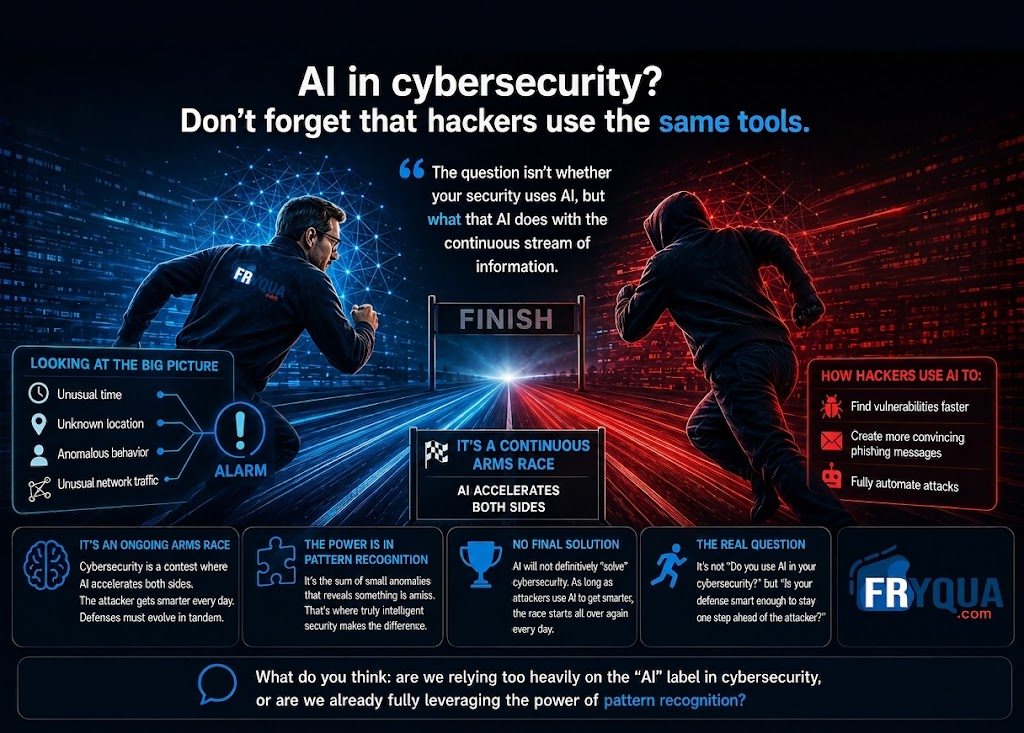
Almost every cybersecurity company is claiming it these days: “We use AI.” AI to detect threats, spot anomalies, and respond faster. Sounds impressive, but it only tells half the story.
The attacker is using the exact same technology.
Because of this, cybersecurity is changing fundamentally. Hackers are deploying AI to find vulnerabilities faster, craft more convincing phishing messages, and fully automate attacks. As a defender, you aren’t facing a static threat, but an opponent that gets smarter every single day.
It is a continuous arms race. Cybersecurity is no longer a simple matter of firewall → antivirus → check → done. It is a competition where AI accelerates both sides.
Why “we use AI” is no longer enough
The question isn’t whether your security uses AI, but what that AI actually does with the continuous stream of information.
A single isolated anomaly doesn’t tell you much:
- A login at an unusual time? Could happen.
- An unknown location? Possibly someone working from home.
- An unfamiliar device? Maybe a new laptop.
It’s only when you combine these signals that the true picture emerges: Unusual time + unknown location + anomalous behavior + unusual network traffic = alarm.
That is where truly intelligent security makes the difference.
Looking at the big picture
At Fryqua, we don’t just look at isolated alerts. It’s about recognizing patterns and connections across the entire environment. A smart hacker rarely does something immediately and obviously “malicious.” Rather, it is the sum of small anomalies that reveals something is wrong.
The power of AI lies not just in faster response, but in looking at events differently. AI isn’t going to permanently “solve” cybersecurity—we shouldn’t make that promise. As long as attackers use AI to become smarter, defenders must adapt. It’s a race that starts over every single day.
So the real question isn’t: “Do you have AI in your cybersecurity?” But rather: “Is your defense smart enough to stay ahead of the attacker?”
Fryqua sees what others miss.
What do you think: Are we relying too much on the ‘AI’ label in cybersecurity, or are we already leveraging the full power of pattern recognition?