
 We are proud to announce a significant expansion of our product, Fryqua Data: the new data classification module! With this addition, we help organizations gain better insight into where their data is stored, how it is classified, and how sensitive it is based on labeling.
What is data classification?
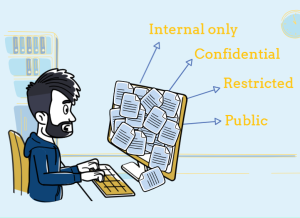
Data classification is the process of categorizing information based on sensitivity and importance. This helps organizations determine which data requires additional security and who is allowed access. Think of confidential customer data, intellectual property, and internal documents that should not be accessible to everyone. An example of classification looks like this:
- Public – No restrictions on distribution (e.g., press releases, marketing materials).
- Internal Only – Accessible only within the organization (e.g., policy documents, internal manuals).
- Confidential – Accessible to specific employees or departments (e.g., customer data, financial reports).
- Restricted – Limited access with additional security measures (e.g., personal data, trade secrets, state secrets).
The classification can be customized based on your needs.
Why is data classification important?
In an era of increasing data breaches and cyberattacks, it is essential to know which data is critical and how it is managed. Without a clear overview, organizations face risks or may not have implemented adequate security measures based on data sensitivity. This can lead to inefficient budget allocation. Some examples of risks include:
- Unsecured sensitive data being accidentally exposed.
- Unauthorized access to confidential information.
- Compliance challenges with regulations such as GDPR, NIS2, DORA, and NEN 7510.
Limited insight into the impact of a security incident and an incomplete audit trail for analysis.
Why is data classification often insufficiently applied?
Despite its importance, many organizations struggle to implement data classification effectively. The main reasons for this are:
- Complexity: Manually classifying data is time-consuming and prone to errors.
- Lack of insight: Many companies do not know where their most sensitive data is located, partly due to outsourcing. Despite this, the organization remains responsible for its data and must demonstrate control.
- Insufficient integration with active monitoring and access management: Without linking classification to active control mechanisms, it remains a theoretical exercise with little practical value. Organizations must actively engage with this process and continuously update it to address growing threats and risks, combined with appropriate measures and follow-ups.
How does our new module solve these problems?
With our data classification module, we make it easy to:
- Apply classification based on predefined or custom categories.
- Gain real-time insight into where sensitive data is stored and who has access, whether on-premises or at third-party providers.
- Directly link security measures to classification so that only authorized users can access critical information.
- Improve compliance by enabling organizations to quickly and easily demonstrate proper management of sensitive data. This can even be integrated with an Information Security Management System (ISMS), ensuring you are always informed about the quality of your information security measures.
📌  With this expansion, we provide a powerful tool to enhance information security and compliance, reduce risks, and make internal processes more efficient. Don’t wait to classify your data and information—start today!
– – – Changelog Fryqua Data – – –